Educated Climber.com

  • Start Here
  • Content
    • Tree Climbing Basics
    • Tree Work Basics
    • Professor Ed Gilman Teaching Series
    • Knots
    • Rigging Basics
    • Chainsaw Basics
    • Basic Jobsite Skills
    • Pests and Diseases
    • Tree ID
    • Small Business Resources
    • Additional Resources
  • Podcast
  • Blog
  • Shop
  • Subscribe

Gary Vaynerchuk’s 10 Rules of Success

August 25, 2017 By patrick@educatedclimber.com 5 Comments

photo courtesy of linkedin.com

“I influence anybody who is able to get through the chaos of my first impression.”
– Gary Vaynerchuk

Gary Vaynerchuk was on my radar for a few years before I ever actually listened or watched his material. I did not like his style at first. He seemed brash and egotistical, not at all what I was expecting. But I stuck around for a few longer podcasts and then it clicked. His message was the opposite of most of the so-called “gurus” out there. Vaynerchuk is an actual practitioner – he runs ‘actual’ businesses, not just ‘online’ businesses. He is not making money online by selling courses that show people how to make money online. You can’t buy his “Hard Work” e-book.

Gary Vaynerchuk was born in the Soviet Union, in Belarus. His family emigrated to the US when he was 3. A born entrepreneur, he is a pioneer in online retailing, social media storytelling, and branding. Clients of his $100 million digital ad agency VanyerMedia include Fortune 500 companies such as General Electric, Anheuser-Busch, and PepsiCo. In addition to his business acumen, Gary is a highly sought-after public speaker, 4-time bestselling author, and an angel investor in dozens of Silicon Valley startups, including Facebook and Twitter. And in his spare time, Gary is a social media influencer with millions of followers, operating under the nickname GaryVee. In other words, Gary Vaynerchuk works harder than you and I do.

So, what does Gary Vaynerchuk have to say about success in life and business in the 21st century? Here are 10 of his go-to themes that have made a big impact on me personally over the last few months:

1. Hustle!

As Gary Vee is fond of saying, “Hustle is the number-one controllable factor of personal success”. You might not be the best looking, or the smartest, or the strongest, but you CAN outwork your competition. As Napoleon Hill famously said, “Create a definite plan for carrying out your desire, and begin at once, whether you are ready or not, to put this plan into action.” Don’t have time? Get up earlier. Don’t play Call of Duty. Don’t veg out on Facebook. Time is not something to be ‘found’ – nobody ‘lost’ it. Time is something to be made. You will make time in your life to accomplish everything that matters to you. You can take that one to the bank.

2. Bet on your strengths. Triple down on what you’re good at and ignore the rest.

Self-awareness is one of the keys to life. Since ancient times, the phrase “know thyself” has had a profoundly important meaning and role in the lives of people trying to better themselves. You can’t be good at everything. When I was young I often heard people use the term ‘jack of all trades, master of none’ in endearing terms, as if this was something to strive for. But in this modern world of information overload, that has all changed. The people who have the biggest impact and the most success these days are the ones who zero in with laser focus on one thing and become the best at it. Do you actually think that LeBron James gave a crap about organic chemistry? Know thyself. Don’t try to be something you’re not.

3. Patience! It’s a marathon, not a sprint.

You have to play the long game. Thinking long-term changes everything. So many other people go on about shortcuts and ‘hacks’, trying to sell ebooks and courses to jumpstart your success. Gary Vee’s message of just putting your head down and working, day in and day out for years before you can even expect success, might seem frustrating at first, but he’s right. Just as anything worth learning is going to take years to learn, so to, anything worth building is going to take years to build.

4. The market, is the market, is the market.

You don’t get to decide what is good or successful – the market does. If everyone else thinks that your stuff is crap, then it’s crap. Sorry. Maybe you are just a unique visionary, a once-in-a-generation genius, but let’s be honest – that probably ain’t the case. Everyone loves to think that they are a unique snowflake…….you however, are not (and neither am I). Look, I get it. Everyone wants to feel special, but really, you’re not Thomas Edison, or Benjamin Franklin, you’re just…well…you. So get over it, and get to work.

5. Ideas are shit. Execution is everything.

There I was, playing road hockey with a tennis ball. I must have been 9 or 10 years old. At some point that summer, it struck me like a flash – I had an invention. I imagined a road hockey puck with wheels so it could slide along the street, I thought it would be awesome! It would need 3 wheels to balance. I was really onto something! Then, about a year later, I saw that exact product in the store. Damn, that was my idea! Do you know how many people claim to have the next great app, or product, or world changing idea? And yet how many of them will actually execute on that idea and make something of it? One out of a thousand? Probably far less than that. Forget about being all secretive with your ideas – share your ideas and be an open book. Become an idea machine and then share the wealth. After all: ideas are shit, execution is everything.

6. Jab, jab, jab, right hook. (Give, give, give, ask)

Before you ever ask for something, you need to give freely of your time, energy, knowledge, and skills. It is the mark of an amateur to try and close the deal on the first interaction. You must build trust, and trust takes time. When trust is involved, it becomes so much more than just a financial transaction. You must always provide more in value that what you are asking in return. This is how you play the long game. You leave money on the table now, so that you can win in the end. Zig Ziglar famously said “You can have everything in life you want, if you will just help other people get what they want”. Deploy empathy, see the world through the other person’s eyes, and help them get what they want.

7. When you give, with expectation in return, you lose.

You know the person I’m talking about. The one who seems to keep score of everything. The one who always feels they are owed something. Or the one who does a favor for you, just so they can ask you to do something for them. Don’t be that guy. It might work for you in the short term, but over time people will eventually catch on and they will resent you for it. As Gary Vee loves to say, “I have zero expectations of others, and that is the reason I’m happy 24/7/365.”

8. The biggest ‘tell’ that someone is a loser – is complaining.

Complainers have the unique ability to suck the life out of a room. When was the last time that you walked away from an interaction with a cronic complainer and said “Wow, that was great. So glad to see that person again!”. Yeah, that’s right, never. You are the average of the 5 people that you spend the most time with, so don’t waste your time with complainers.

9. Ignore the Opinions of Others

Most people are being held back by others. Often times it’s not explicit. Your mom isn’t going to come to you and say that she will lose respect for you if you fail. But in your imagination, that is exactly what you think will happen. So you make excuses. “Well, I would go for it, but what about all the ‘I told you so’s ‘ if it doesn’t work out?”. “I don’t want to look like a fool”. “I can’t do ‘x’ because I need to pay the bills today, and the crappy job that I have is already doing that for me”. So, what? You’re going to stay in that crappy job for another 15-20 years just because it pays your bills for the time being, or just because your mom gets to tell her friends that her kid has a ‘nice, steady job’? Stop caring about what everyone thinks about you, or wants for you. Grow up and do what’s right for you. You can’t please everyone, and why would you want to? You just do you, and the rest will work itself out.

10. Legacy matters. Who will be at your funeral?

How you make your money is far more important than how much money you make. The internet is full of slimebags who make a ton of money in shady ways. But you know what? If you were at a party and you met one of these people and you asked them, or their significant other, how they make a living – they would be embarassed to tell you. And why is that? Because they should be. If you generally care deeply about how history will look back on you, I guarantee that you will put more thought into the actions and decisions that you take, in business and in life.


Well, there you have it. The bar has been set high. If you have plans and ambitions and lofty goals, it’s time to stop watching inspirational videos. It’s time to stop reading business and self-help books. Stop waiting for all the stars to align, for all the lights to be green. Just start working. Start from where you are, with what you have. Conditions are never going to be perfect. Right action, combined with honest intentions, coupled with empathy and gratitude can take you where you want to go. Your job…is to put in the work. Got it?


“If you’ve lost your hustle, it’s because you aren’t in tune to why you’re doing it”
– Gary Vaynerchuk


Check out Gary’s bestselling books for a shot in the arm of entrepreneurial savvy and timeless, practical advice to take you from where you are, to where you want to be in the 21st century world of business.

Crush It! Why Now Is The Time To Cash In On Your Passion

The Thank You Economy

Jab, Jab, Jab, Right Hook – How To Tell Your Story In A Noisy Social World

#AskGaryVee – One Entrepreneur’s Take On Leadership, Social Media, and Self-Awareness


To learn more about Gary Vaynerchuk, check out the links below:

Website: garyvaynerchuk.com
Youtube: youtube.com/user/garyvaynerchuk
Podcast: GaryVee Audio Experience
Facebook: facebook.com/gary
Twitter:  twitter.com/garyvaynerchuk
Instagram:  instagram.com/garyvee
Medium:  medium.com/@garyvee
Wikipedia:  https://en.wikipedia.org/wiki/Gary_Vaynerchuk


Climb high, Work smart, Read more.
– TreeMuggs

I would love to hear from you. Please send all comments/questions/hatemail to patrick@educatedclimber.com


Filed Under: Blog

Before the Work Begins

July 10, 2017 By patrick@educatedclimber.com 11 Comments

“We are not at our best perched at the summit; we are climbers, at our best when the way is steep.”
– John W. Gardner

Early morning. Before the saws and chipper break the silence. While you can still hear the birds calling to each other. You’re itching to get started. All anticipation and nerves. Maybe you had too much coffee. You just want to get up there. Do something meaningful with your day.

Patience.

When the canopy is so accessible and inviting, how could you be content to stay on the ground? Trees call to you. Maybe it’s a primate thing. You were made to climb and swing and hang, that’s what feels natural. It’s in your blood. It’s who you are. It’s who we all are. Most people just don’t know it. But you do. You feel the call.

Patience.

Climbing makes you feel like a kid. It was something you used to do for fun. Not because someone said you had to. Not because a teacher said you should. Not for your parents. Just for you. And now you get to do that for a living? How cool is that?

Patience.

Today, rather than talking about climbing, I wanted to take a look at some of the pre-game rituals of production tree work. Because the climbing, cutting, and rigging is only one aspect of tree work. There is a lot more that goes into a successful tree job, before the job even begins. So let’s just slow down a bit and explore some of those things before we get climbing…

Person in Charge

On every job site there must be a qualified arborist in charge of operations. The ANSI Z133 – American National Standards for Arboricultural Operations, Safety Requirements, defines a “qualified arborist” as:

  • “an individual who, by possession of a recognized degree, certification, or professional standing, or through related training and on-the-job experience, is familiar with the equipment and hazards involved in arboricultural operations and who has demonstrated ability in the performance of the special techniques involved.”

Leadership

Just because someone has been deemed to be “in charge”, do not assume this makes them a good leader. Leadership is a huge topic of which entire books can be found, but in my mind, leadership comes down to communication and ownership.

  1. Communication
    An effective leader communicates well. That’s the bottom line. How can an employee be held accountable for anything, (anything!), if they haven’t been trained properly and effectively on exactly what their responsibilities are, how to complete all of the tasks assigned to them, and how those tasks fit into the framework of what everyone else on the jobsite is doing? Do not assume anything of any employee, especially the new guy!
  2. Ownership
    If you are in charge and something goes wrong, it’s your fault. End of story. That’s ownership. You may not like that, and it may not seem fair, but guess what? That’s reality.

Safety Mentality

Although the person in charge is ultimately accountable for the job, the entire crew shares the responsibility for safety and they should help to assess the jobsite. All crew members are responsible for their own safety as well as the safety of others. On a crew, everyone looks out for everyone else. However, never assume that someone else is more interested in your own personal safety than you are. This may sound contradictory at first, but it will probably make more sense the longer you work in this trade.

Roles and Responsibilities

In addition to recognizing that there is one person on-site who is ultimately responsible for the job, it is critical that everyone else knows their roles and responsibilities. When people operate in groups, clearly defined roles can make the difference between success and failure. Tasks that are just taken care of “by everyone” are the ones that most often cause problems. Roles and responsibilities cannot be fuzzy. Everyone loves to play the blame game and pass the buck, but the true professional takes responsibility because he knows what is required of him. Again, this concept of clearly defined roles derives from strong leadership and communication.

Emergency Preparedness

A critical part of personal responsibility for all arborists is that they are ready and prepared to respond to an emergency situation. Basic preparation includes:

  • Know the location where you are working, including street address and basic directions.
    – this information would be crucial in an emergency, e.g. calling 911
  • All tree care workers must know location of first aid kits and fire extinguishers.
  • Training in first aid and CPR is invaluable for all workers.
  • All workers should have basic knowledge of aerial rescue scenarios including bucket truck and climber rescues (High Angle Rescue).
  • All workers must be proficient with ground controls for bucket trucks.
    – this would be crucial in an aerial rescue situation where bucket operator was incapacitated or bucket controls were not functioning properly
  • Bucket truck operators must always carry an emergency rope that will reach the ground, and be experienced in bailing out of a bucket at height

Site Inspection and Jobsite Staging

Before commencing work, the jobsite must be examined for moveable and immoveable targets. I bet you never knew how much money there was in lawn ornaments, solar lights, and little gnomes until you got into this business, eh?

  • Move everything that can be moved, and try to remember where it goes so you can put it back when you are finished.
  • Tie back shrubs or branches along drag path or make some small trimming cuts if necessary.
  • Make sure gates or fences are propped open, tie back if necessary.
  • Unscrew drainpipe extensions if they are in the way and put in a safe place, to be replaced at the end of the job.
  • Make sure the chipper is angled away from the house so that long branches do not scrape the siding as they get drawn in by the feed wheels.

Job Briefing/Tailboard Talk

Don’t just fire up the chipper and grab the polesaw. Take the time to have at least a quick tailboard talk. The following details must be understood by the entire crew before work begins:

  • Roles and Responsibilities: who is responsible for what.
  • Scope of Work: everyone must know exactly what is to be done onsite.
  • Gear: all necessary gear is onsite and ready to go.
  • Crowd control: you must be proactive about pedestrians and bystanders walking onto your jobsite. Cones, caution tape, signs, flags, etc, etc. They will walk around all of those things. Trust me on this. Be aware of it.
  • Plan: everyone must know the basic plan, including safety considerations, how the work will be done, what the drop zones/landing zones are, what the drag path will be, etc.

Tree Inspection

Before any work begins on a tree, it must be inspected from the ground. Proper and thorough tree inspection requires experience and patience. Unsafe trees should not be climbed or rigged from. Tree inspection is too broad of a topic to tackle here, so let’s just look at the basics.

These are some of the major hazards to be aware of when inspecting a tree (not a comprehensive list):

  1. Large dead wood, widow makers, and hangers
  2. Cavities
  3. Cracks
  4. Weak Branch Unions (i.e tight crotches)
  5. Decay
  6. Mushrooms (fruiting bodies)
  7. Cankers
  8. Root problems (i.e. digging/construction, poor soil drainage, mushrooms, etc)
  9. Poor tree form (i.e. lean, storm damage, improper pruning, topping, etc.
  10. Lack of taper
  11. Structural defects
  12. Loose bark
  13. Electrical wires
  14. Insects/animals

Heart Rot vs. Sap Rot

Knowing a bit about wood decay fungi is critical to proper tree inspection before work begins. Identifying the fungus type (heart rot vs. sap rot) and assessing overall tree vitality can help forecast the spread of decay.

Heart rot refers to any fungus that erodes wood tissue from the inside out. As most arborists are aware, trees that have extensive internal decay and hollow portions can still retain an immense amount of strength. This is because the most important factor in stem strength is the integrity of the cambium – the outer few inches of the tree. Sap rot refers to any fungus that erodes wood tissue from the outside in, and is considerably more dangerous than heart rot. For this reason, it is critical that tree care professionals are able to distinguish heart rot from sap rot.

Distinguishing Heart Rot from Sap Rot

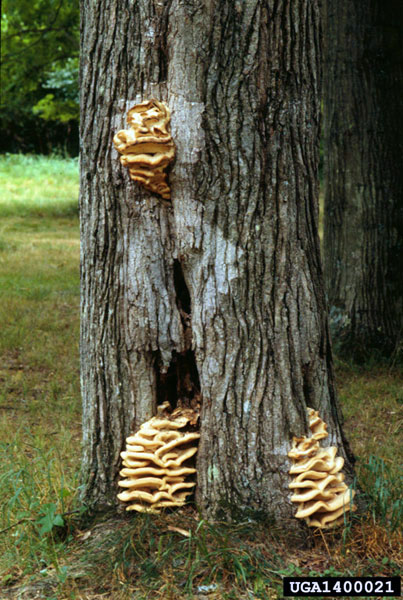
Heart rot fungus is generally recognized by the presence of large fungal fruiting bodies, also known as conks or mushrooms. These usually occur in small numbers and are localized. Mushrooms such as this are usually a sure sign of extensive internal decay. However, trees with such decay can live for a very long time without failing, due to the nature of heart rot and the biological structure of tree stems.

Heart rot fungus (photo courtesy of extension.umn.edu)

Heart rot fungus should be considered a yellow flag when evaluating tree integrity, as it may or may not indicate a significant risk factor for tree workers.

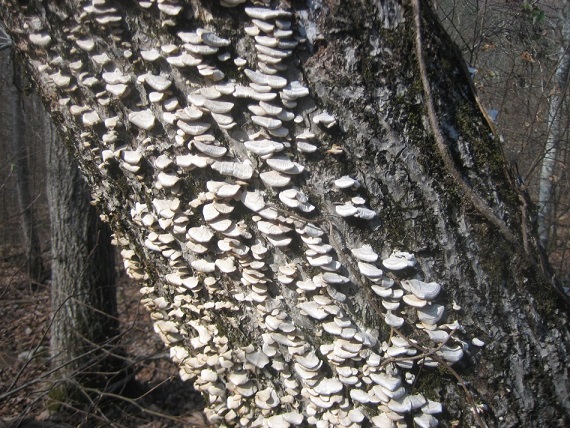
Sap rot fungus is usually recognized as smaller fruiting bodies in large numbers that can cover large areas of wood. This type of fungal decay is far more dangerous than heart rot, as it can dramatically effect the strength and structural integrity of a stem.

Sap rot fungus    (photo courtesy of ouachitamaps.com)

Stems with extensive sap rot such as this shown here are prone to failure under the stresses of rigging and/or climbing operations, and extreme caution must be exercised before beginning work on such a tree. Sap rot fungus must be considered a red flag when evaluating tree integrity, as it almost certainly indicates a significant risk factor for tree workers.

The Mental Game

Ok, so you have prepped the jobsite, everyone knows what the job entails and what their role is, and you have determined that the tree to be worked on is safe to climb. Now just jump up there right? Patience.

Before you go aloft, you need to make sure that your head is in the game. Dangling from a little nylon rope with a running chainsaw is not a lighthearted endeavor. Do not make the mistake of thinking that you are ready just because your ropes and your muscles can get you up there. Climbing requires a tremendous amount of mental focus and clarity. I know for myself, the times that I have struggled the most were the times that my head wasn’t fully in the game. I simply cannot do my best work when my mind is preoccupied with all the affairs that I failed to leave behind on the ground. Each move, each cut, requires visualization and foresight, and I simply cannot give it the attention it deserves if I am not fully immersed in the moment.

I have one small ritual that I do from time to time when I feel like my mind is racing before a climb. I put my hand on the bark, close my eyes, and just breathe. I try to feel a connection with the tree. This helps bring me back to center and re-focus my thoughts on the task at hand. Then, when I open my eyes, I am calm and ready to go.

Get Up There

Climbing arborists come from all walks of life. Some climbers are slow and cautious, deliberately planning each and every move to keep their monkey mind in check. Others are full of piss and vinegar, halfway up the tree before the rest of the crew has even gotten out of the truck. We are each so different, but yet, we feel a close bond to one another, as if we are all part of the same family. We also feel a special bond to nature. Our work affords us a very unique viewpoint on the world. Trees are amazing and majestic, but they demand our utmost respect. We do not take climbing lightly. We cannot.


Climb high, Work smart, Read more.
– Patrick


I would love to hear from you. Please send all comments/questions/hatemail to patrick@educatedclimber.com


Filed Under: Back To Basics, Climbing

Email Scripts

June 19, 2017 By patrick@educatedclimber.com 6 Comments


Here are a couple email scripts that we use to communicate with our customers. Feel free to copy or modify them as you need.

Scheduling Jobs:


Good afternoon [name], we are planning to get your tree work done at some point next week, [date range]. If you prefer a certain day or time for us to be there, or if next week is not good timing for you, please reply to this email and we can schedule something specific. If a change of schedule or inclement weather prevent us from completing the work next week, we will notify you as soon as possible to make alternate arrangements. We look forward to completing this work and we thank you for your patience.

Important Reminders:

1. Lawn Ornaments (including solar lights, garden decorations, moveable bird feeders, etc.)
We will make every effort to move these items before beginning our work and to put them back when we are done. However, we do recommend that our customers take care of this themselves, before we arrive. This will help ensure that none of these items gets missed, as well as ensuring that all items get put back in their proper location after job completion.
While we strive to double-check for these items before we begin so they can be moved to safety, please note that ConservaTree Inc. cannot be held responsible for damage to such items.

2. Customers with Dogs
Your tree work will require ConservaTree staff to have access to front and/or back yard properties, including those areas frequented by dogs. For the sake of our staff, please ensure that all dog waste has been carefully removed and disposed of. We thank you for your consideration.
In addition, if you have pets that normally roam freely outside, please ensure for their safety that they are kept inside while we are working.

3. Access to Property
Please help to ensure that our staff have the required access to your property by moving vehicles, unlocking gates, etc. If we arrive and are unable to complete the work because of such issues, your work will be delayed until we can make other arrangements with you.

4. Billing
We do our billing through email. Shortly after the work is completed you will receive an email with an invoice and payment options. We also offer paper billing if you prefer.


After Job Completion


Good afternoon [name], we are pleased to say that your tree work was successfully completed today, [date]. We trust that you are happy with the work carried out by our professional staff and that everything was done to your satisfaction. Your invoice is attached, in pdf format.

Payment Methods
We are pleased to accept payment by cash, cheque, or credit card.
1. Cash – please contact us to make arrangements for paying by cash.
2. Cheque – please send cheque along with a copy of your invoice to the address below:
ConservaTree Inc.
PO Box 51019
London, ON N5X 4E0
3. Credit card – please go to our website to pay by credit card (www.conservatree.ca). Click on the “Pay Online” link at the top of the page to process your payment.

Customer Feedback
We strive to maintain an open and active dialogue with our customers and we encourage all customers to leave feedback upon completion of work. We accept all feedback through our website.
– If paying by cash or cheque, please follow this link [link] to our feedback form.
– If paying by credit card, you will be taken directly to our feedback page upon successful completion of your online payment. See instructions above for paying by credit card.

On behalf of the ConservaTree team, I would like to personally thank you for your business and I sincerely hope you will refer us to friends, family, and colleagues. Our goal is to form long-term relationships with our clients and their trees. We look forward to working with you again in the future!

Patrick Masterson
Arborist and Owner, ConservaTree Inc.
www.conservatree.ca


Climb High, Work Smart, Read More.
– TreeMuggs

I would love to hear from you. Please send all comments/questions/hatemail to patrick@educatedclimber.com


Filed Under: Small Business Resources

Estimate Sheet

June 19, 2017 By patrick@educatedclimber.com 4 Comments


This is the estimate sheet that I developed in our first year of operation. I kept modifying it over and over to get to something that would fit most job quote situations. I’m happy with the final product. Feel free to modify it as needed or just pick and choose parts of it to use for your own needs. Let me know what you think.

Front:

ConservaTree Estimate Sheet Front – FINAL
Download as PDF


Back:

ConservaTree Estimate Sheet Back – FINAL
Download as PDF


Climb High, Work Smart, Read More.
– TreeMuggs

I would love to hear from you. Please send all comments/questions/hatemail to patrick@educatedclimber.com


Filed Under: Back To Basics

Subcontractor Agreement

June 19, 2017 By patrick@educatedclimber.com 3 Comments


This is a subcontractor agreement that I developed after wading through many similar documents available online. Although most subcontractors that I know would never bother to use anything more formal than a handshake, this type of agreement may come in handy for someone at some point. Feel free to use it as-is or modify it to your liking. Let me know what you think.

BLANK Subcontracting Agreement Oct 2012
Download as PDF


Climb High, Work Smart, Read More.
– TreeMuggs

I would love to hear from you. Please send all comments/questions/hatemail to patrick@educatedclimber.com


Filed Under: Back To Basics

  • « Previous Page
  • 1
  • …
  • 6
  • 7
  • 8
  • 9
  • 10
  • …
  • 13
  • Next Page »
  • The Manifesto
  • Subscribe to EducatedClimber
  • EducatedClimber on Youtube
  • Disclaimer
  • Amazon Affiliates Disclosure Page

Copyright © 2026 — Educated Climber.com • All rights reserved.