Educated Climber.com

  • Start Here
  • Content
    • Tree Climbing Basics
    • Tree Work Basics
    • Professor Ed Gilman Teaching Series
    • Knots
    • Rigging Basics
    • Chainsaw Basics
    • Basic Jobsite Skills
    • Pests and Diseases
    • Tree ID
    • Small Business Resources
    • Additional Resources
  • Podcast
  • Blog
  • Shop
  • Subscribe

Integrated Tree Management Plan (ITM)

June 19, 2017 By patrick@educatedclimber.com 2 Comments


This is a concept that I came up with a long time ago (around 2010), but I didn’t really develop it until quite recently. This is a strategy and framework for selling tree care services to customers with large numbers of trees, primarily condo corps, golf courses, cemeteries, institutions, industrial and commercial outfits, etc. Our big push at ConservaTree Inc., as of 2017,  is to move away from residential tree work, and move most of our resources towards working with B2B customers, with the idea of having fewer customers but larger projects. The ITM framework is the backbone of that business strategy.

The idea for the Integrated Tree Management plan came from IPM – Integrated Pest Management, wherein you define monitoring schedules, thresholds, and control strategies for dealing with specific pests in the landscape. IPM is usually deployed in large-scale horticultural management situations, where you very-specifically define what you are trying to achieve in regards to insects and pests around valuable plant and nursery materials.

In a similar fashion, Integrated Tree Management allows property managers and arborists to communicate a vision and shared goals for collections of trees. Using this framework, a formal management plan is drawn up between the tree care company and the property manager, ensuring that everyone knows what is expected of them. Rather than fuzzy ideas of what is trying to be achieved, the ITM concept allows for concretely defined standards and ongoing monitoring to ensure the health and vitality of cherished landscape trees, now and into the future.

Integrated Tree Management Plan (ITM)

As our name implies, ConservaTree is committed to all aspects of tree conservation, preservation, and environmental stewardship. The urban forest is about more than individual properties. It is about neighborhoods and the community as a whole. Trees take so long to grow – let’s protect what we’ve got!

ConservaTree Inc. offers property managers the most comprehensive service, maintenance, and management program in the industry – the Integrated Tree Management Plan (ITM).

Our Integrated Tree Management Plan begins with a thorough walk-through and site assessment by experienced and knowledgeable Certified Arborists. We strive to gain an understanding of your goals and vision of the future while addressing any ongoing concerns you may have. Our staff take the time to answer your questions and make recommendations tailored to the situation. Our aim is to assess the needs of the landscape, the community, and the property management team, working with you to identify problems and visualize solutions.

Your management plan is designed to help achieve the highest degree of safety, utility, and aesthetic value of trees on site, helping to preserve their beauty for years to come. ConservaTree is here to help ensure that your trees are given the best care by qualified professionals.

Your Integrated Tree Management Plan will address:

  • Tree species: which trees are recommended vs. not recommended
  • Site and soil conditions
  • Health and Vitality
  • Pests and Diseases
  • Ongoing issues
  • Planning for the future

Services include:

  • Twice yearly onsite monitoring and visual inspection
  • 24/7 Emergency service
  • Tree pruning, trimming, removal, fertilization, planting, consulting
  • Adherence to modern safety and industry standards
  • Traffic and pedestrian control to ensure the safety of the community

At ConservaTree, we commit to treat every tree and every property as if they were our own. This includes giving honest advice and assessment, performing top-notch, quality tree work, and providing full and comprehensive cleanup as part of every job. From start to finish, we raise the bar for tree care, consulting, and customer service.  That is our commitment and our pledge to you, our valued customers.


Climb high, Work smart, Read more.
– TreeMuggs

I would love to hear from you. Please send all comments/questions/hatemail to patrick@educatedclimber.com


Filed Under: Small Business Resources

Close Call: Rigging Point Failure

May 24, 2017 By patrick@educatedclimber.com 10 Comments


A couple weeks ago I had a very close call rigging out the last top on an ugly Silver Maple at the cemetery. My rigging point failed and a 25 ft chunk of log went freefalling towards the earth. Nobody was hurt – thank God. One stone got hit but it didn’t do any damage. As fate would have it, my apprentice wasn’t there that day to see and learn from what happened. After talking it over with Dr. Jack Daniels and thanking the heavens, I believe it ultimately comes down to complacency and normalcy bias: the top was just too big, and I knew it.

I want to provide some context before you watch the video.

We recently got this contract for taking care of the trees at one of the largest cemeteries in the city. This place is amazing: crypts, mausoleums, 25 ft tall stones, a massive herd of deer that you see every time you go in there. But, like most cemeteries around here, they have some trees that have been left too long and have now become hazardous.

The tree in question was an 80 ft Silver maple, long past its prime. The tree had 5 main leaders, 2 of which were stone dead, 2 seemed relatively ok, and the 3rd seemed halfass – it had quite a bit of life up top. The 2 good leaders were on opposite sides of the tree, everything in the centre was dead. This tree was total sketchbag, I refused to climb it. We have access to a 60ft spider lift sometimes on the weekends, which seemed perfect for the cemetery work, drive it right in, between the stones, set up right beside the tree.

So, we got set up and I went up to set my pulleys and take stock of the situation. Right away I had a bad feeling about it, from the moment I realized that I couldn’t reach the crotch on the tallest top. I was about 6 ft below it, which meant that the last cut would be a good size top, which goes against two of my golden rules:
1. “Go big or go home” vs “Go small AND go home”.
2. Always trust that little voice in the back of your mind

But I got set up anyway and started piecing it down, rigging almost everything. I figured that we would end up moving the spiderlift to the other side of the tree to finish, and so maybe I would be able to reach higher on that top from there. Everything went smooth, I was splitting the load between that tallest leader and the halfass leader – the one with the live top. This leader had woodpecker holes and peeling bark but it didn’t seem that bad, relatively speaking. I ended up taking the top off of it but leaving the spar for my pulley. To finish, I moved the lift around to the other side of the tree, hoping that I would be able to reach a little higher on that tallest top, but I realized that I had no better reach from this side. So there I was, the last top waiting to be cut, the load split between that spar and the other one.

From Wikipedia: “Normalcy bias causes people to underestimate both the possibility of a disaster and its possible effects, because it causes people to have a bias to believe that things will always function the way things normally function. This may result in situations where people fail to adequately prepare.” That pretty much sums it up. I knew the top was bigger than what I would normally take, but that’s all I could reach with the lift. Keep in mind, this is the last top on a Friday, they needed it done yesterday, and I had already spent over $1000 on this lift (we used the lift for more trees than just this one). So, rather than packing it in and telling the crew that we would have to figure out some other option for finishing this, I said “screw it, I’m just gonna hope for the best”…   Not my best decision. Boy am I ever glad I got it on video.


You can see how shaken up I was in the video. I could barely put my saw back in the scabbard and I couldn’t talk for a few seconds. This was easily the worst thing to happen to me in tree work so far – this is my 10th year of production work. You can see that Rob let the top run and as soon as he slowed it down you can hear a ‘pop’ and then this log comes flying past my head from the right side. The instant that shock load hit the rigging, it broke that stem clean off. Upon further inspection, where it broke there was a squirrel nest with babies all curled up. There was only about a half inch of good wood around the outside of that spar, but it had been supporting a live top for many years.

I take full responsibility for this accident. Like most things, it wasn’t just a single detail that got overlooked. It was several things combined. I was the boss, mistakes were made. I felt the pressure of trying to get this job done, they needed it asap, we had already cancelled once, we were heavily invested after renting this lift. My gut told me that the top was too large: “Go small AND Go home”. You have to trust that still, small voice – only you know when something doesn’t feel right.

Here is the ultimate irony in all of this: I refused to climb and rented a piece of equipment to try and be safer, but because of the limitations of that piece of equipment, I ended up doing something more dangerous than I otherwise would have done. Had I been climbing, I never would have taken a top that big, I would have gone up to the crotch and done it in two pieces.

In addition to the size of the top, I can name 3 things right off the bat that I could have done to increase my chances of success in this situation:
1. Fishing Pole technique down the stem that broke, to spread the load more evenly
2. Portawrap should have been rotated around the trunk so that the rope was directed straight down that stem
3. Maybe a higher-stretch rigging line would have helped to absorb some of the shock load

But the bottom line is this – the top was just too big for the situation in that particular tree. Don’t look to your equipment to help you overcome the realities of physics. Physics is unforgiving. Physics doesn’t care if you have 3 kids and a wife waiting for you at home. Physics doesn’t care how many years you have been climbing, or how many tops you have rigged out. With physics, it’s not personal – it’s just business. Being unable to reach something because of your equipment is no excuse to cut stuff that is too big. In production work, we all end up taking chances now and then, but chance has no memory! Getting away with it 99 times does not mean that #100 will work out in your favor!

The pressure to perform may feel externally driven, but ultimately it comes down to internal choices. If you make a bad decision and you get hurt or you hurt someone else, you don’t get to blame it on the boss. You don’t get to say “I was just hoping to get home by 6 so I was working faster than I should have”. If there is one thing that I know in this trade, it is this: When things go bad, they go really bad, really fast. Only you are responsible for your choices. A professional doesn’t shirk responsibility, he leans into it. With great responsibility comes great power. If you are not prepared to take full responsibility for your actions, then please: stop, breathe, re-think the situation. Don’t just say “screw it” and hope for the best. Don’t play games with physics, you are bound to lose in the long run.

Stay safe out there.

Continue Reading: Personal Responsibility


Climb High, Work Smart, Read More.
– TreeMuggs

I would love to hear from you. Please send all comments/questions/hatemail to patrick@educatedclimber.com



Filed Under: Back To Basics

Victory Garden Update: May 22, 2017

May 23, 2017 By patrick@educatedclimber.com 3 Comments

Last year I grew pumpkins in wood chips and I was amazed with the results, so this year I converted my entire garden over to mulch. This is another big experiment for me, we’ll see if it pays off. The concept makes so much sense, it makes me wonder how I never saw it before.


The idea came from the Back to Eden documentary from a few years back.


Stay tuned for more garden updates, hoping for a big growing season!


Climb High, Work Smart, Read More.
– TreeMuggs

I would love to hear from you. Please send all comments/questions/hatemail to patrick@educatedclimber.com


Filed Under: Back To Basics

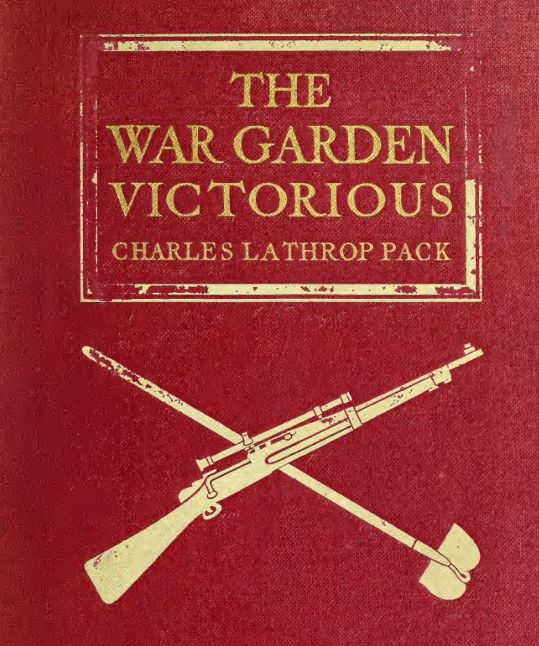
The War Garden Victorious

May 16, 2017 By patrick@educatedclimber.com 5 Comments

“There is nothing new except what has been forgotten.”   – Rose Bertin

The year is 1917. Woodrow Wilson is President of the United States. After more than 2  1/2 years of intense fighting, the Great War rages on, and the food supplies of Europe are at a critical low. Farms have long since been stripped of their male workers, and the farms of so much of France and the low countries lay in waste. Rationing isn’t enough. With large swaths of Europe on the verge of famine, creative solutions are being sought.

Charles Lathrop Pack (1857-1937) was a successful 3rd generation timberman, and one of the 5 wealthiest men in America prior to World War I. He served as president of the American Forestry Association, one of the principal advocates of the early forest conservation movement, and later founded the American Tree Association, contributing some of his millions to further research in forestry and forest education.

In March of 1917, some weeks before the US entered the war, Pack organized the US National War Garden Commission, to encourage men and women on the homefront to contribute directly to the war effort by converting urban spaces into productive gardens and mini-farms. This is the story of the movement he founded.


From the first chapter:

“The war garden was a war-time necessity. This was true because war conditions made it essential that food should be raised where it had not been produced in peace times, with labor not engaged in agricultural work and not taken from any other industry, and in places where it made no demand upon the railroads already overwhelmed with transportation burdens.

“Before the people would spring to the hoe, as they instinctively sprang to the rifle, they had to be shown, and shown conclusively, that the bearing of the one implement was as patriotic a duty as the carrying of the other. The idea of the “city farmer” came into being. The creation of an army of soldiers of the soil presented much the same difficulties presented by the creation of any other army. First of all there was the matter of recruiting. This was a purely volunteer movement and all recruits must come through voluntary enlistment. Then it was necessary to point out the importance of the work and to create enthusiasm for gardening. Next, it was necessary to train the recruits. Intelligent instruction had to be furnished, for many of these new soldiers of the soil had never before handled a hoe or a garden fork. So unexpectedly great was the response to the campaign that it proved essential to turn attention to the matter of food conservation, to the preservation of surplus products which the garden campaign had brought into being.”


Initially referred to as War gardens, the name was changed to Victory gardens after the conflict had ended. This name was resurrected with the onset of World War II when, once again, food production would become critical to the war effort.

It is my sincere wish that this volume will be of help once again, in these times of growing uncertainty. Detailing both food production and food preservation methods, part narrative and part instruction manual, this classic little book is as timely now as it was 100 years ago. Learning the skills of food gardening at home is a worthy and meaningful undertaking for both adults and children alike. Putting these skills into practice gives one a sense of empowerment, independence, and, maybe in some small way, a measure of control over our circumstances.

Together, let us channel that pioneering spirit of a bygone era, and each do our part, by growing our own “Victory” gardens.

Will you have a part in victory?

Patrick Masterson
H.A.F. Publishing
April, 2020


Free Ebook available below:


The War Garden Victorious by CL Pack – HAF Publishing – No Coverx

Download as PDF


source: archive.org


Climb High, Work Smart, Read More.
-TreeMuggs

I would love to hear from you. Please send all comments/questions/hatemail  to patrick@educatedclimber.com


Filed Under: Blog

The Tree Doctor

May 7, 2017 By patrick@educatedclimber.com 2 Comments

source: Amazon.com

Originally published in 1902, John Davey’s classic work helped to establish the scientific basis for the modern profession of ‘arborist’ or ‘tree surgeon’. John Davey believed that people’s neglect for trees was simply the result of a lack of understanding of their functioning, and that educating the public on proper tree care could benefit the entire country.  This book laid down a foundation for tree care standards that would be adopted by his company, including proper finishing cuts, planting, timing, pests and diseases, and urban cultivation. John Davey’s study of tree stress, wounds, rot and decay was ahead of his time. Although many of his theories were later shown to be off-track, his contributions to the trade at the time were immense – he helped to pioneer an industry.

From Wikipedia:

John Davey (June 6, 1846 – November 8, 1923), considered the father of the science of tree surgery, was born in Stawley, Somerset, England. Although he did not learn the alphabet until his early 20s, his sharp intellect and analytical skills allowed him to become a skilled orator, author, publisher and inventor.

John Davey mastered agriculture under the tutelage of his father, the superintendent of a large farm. He developed a strong work ethic and passion for arboriculture. Davey believed that great lengths should be taken to preserve natural resources, especially those that take more than a lifetime to replace.

He took his convictions to America in hopes of preserving ailing trees and providing quality horticultural services. He subsequently launched a landscape and greenhouse business in Warren, Ohio, and then, in 1880, founded The Davey Tree Expert Company in nearby Kent.


From the Introduction:

“The author of The Tree Doctor has had the care of trees and plants for more than thirty-five years and is an ardent lover of nature. The ghastly wounds of his friends, the trees, and their various suffering (if you will allow the expression) cry aloud and pierce his inmost soul and bid him arise and plead their cause. The author is not so conceited to suppose he “knows it all.” Whatever knowledge he possesses he has learned from others, or gained it from observation. If nature has endowed him with the faculty of observing and the ability to trace effects back to their causes, and thus enable him to find the two real causes of the present sickness and premature death of trees, then, as a member of society, he owes that knowledge to the world at large, and particularly to the United States of America, his adopted and beloved “home” to which, with pleasure, he reverently dedicates this work.”

The Tree Doctor is available in paperback from Amazon.com here.


treedoctorbook optimized 2nd try
Download as PDF


source: archive.org


Climb High, Work Smart, Read More.

-TreeMuggs

I would love to hear from you. Please send all comments/questions/hatemail  to patrick@educatedclimber.com


Filed Under: Back To Basics

  • « Previous Page
  • 1
  • …
  • 7
  • 8
  • 9
  • 10
  • 11
  • …
  • 13
  • Next Page »
  • The Manifesto
  • Subscribe to EducatedClimber
  • EducatedClimber on Youtube
  • Disclaimer
  • Amazon Affiliates Disclosure Page

Copyright © 2026 — Educated Climber.com • All rights reserved.